I’ve titled this ‘Unschooling- Part 1’ because the current term used to describe our family’s approach to education is commonly referred to as unschooling, although I prefer the terms ‘natural learning’, ‘organic learning’ or ‘child-led learning’. The ‘part 1’ is an indication that this is a process; something that will evolve and change with our family as we explore what works for us and our individual needs and I intend to be transparent about our journey.
I recently listened to a podcast that really resonated with me, it interviewed a lady who has never been to school or had a formal class on any subjects, she was technically unschooled before that term was even a thing. What struck me most about this interview was that unschooling for this family wasn’t an academic choice necessarily, it was rather a by-product of a chosen lifestyle and I was like ‘YES! ME TOO!’ (I often have these one-way conversations with podcasts, I end up feeling like I’m best friends with some of the hosts/guests, does anyone else?!) Anyway, for those interested it was episode 25 of the Rogue Learner Podcast, titled ‘A Grown Unschoolers Perspective’.
For those that are unfamiliar with the term, ‘unschooling’, it is a name often used to describe families who choose to leave their children out of the formal education system, including any type of curriculum at home, any scheduled timetable of any sorts that is created within the confines of school hours and/or dedicated buildings or ‘learning environments’. Basically, unschooling confidently puts the child in charge of their own learning, ironically without emphasising the learning aspect, because within this community of likeminded individuals, we believe a child is always learning, and it is during the coercion, persuasion and expectations that a desire to learn dwindles, creating the exact opposite of what the intention was by the teacher/parent. There is no one correct way to unschool, it will be different for every child and every family. There is no manual, no guidebook and no curriculum. There is no targets or goals. It is, in my eyes, gifting your child the chance to live without oppressive relationships and forced academics. This lifestyle encourages respectful democratic power within the home.
Understandably, this concept really seems to challenge people. I too, doubted it was a thing, and even now I am deep in the process of ‘de-schooling’ myself in order to fully support and trust my girls in this process. Unschooling was never on my radar, it’s a term I have only become familiar with within the last 18 months or so. Granted, when I became pregnant with my first, almost 6 years ago, I began to question what schooling/childcare would look like for my family. I knew immediately that a normal school just wasn’t going to be the right fit for us; we were a vegan family, we only eat organic, we only like buying natural fibre clothes (school uniforms are synthetic and highly toxic!), we don’t use chemicals, we avoid most plastics…yeah, we’d have been the weird family in the playground for sure! So, when we stumbled upon the Steiner school when visiting Totnes, we fell in love with it. It was the most nourishing space; wood everywhere!!! A minimalistic room that resembles the calming environment you’d want at home, hand-made toys gently lined on wooden shelves, play-silks/pegs and frames, an open kitchen where the children cook daily with their teacher, emphasis on organic food, vegetable patches, chemical-free art, candles and songs…the rhythms, the ritual…it ticked all our boxes. That was the plan, it was set, Willow would go there when she turned 3, we even paid the registration fee. But the summer before it was meant to happen, Wren was born. This changed everything. Suddenly the concept of sending Willow away from us, no matter how great the environment, seemed ridiculous. She struggled with the transition to being a big sister anyway, so to create her a separate world, away from ours seemed a little ludicrous. It was actually Rich that first voiced this (always a man to speak his mind), he had concerns that her BIG personality would be squashed (albeit it kindly) within the calm, orderly setting of a Steiner Kindy. Because if there’s two things that willow isn’t, its calm and orderly. She is explosive, loud, opinionated and athletic. She of course was only 3 years old too, tender and delicate and still very attached to me, her mamma, her world. We thought about what was being offered to her at Kindy; rhythm, cooking, gardening, socialisation…well, we do all of that every day at home. And home is where I was anyway caring for a new-born, so the decision was made to have both girls at home with me (ironically, this is the norm in many cultures around the world but for some reason people are obsessed with children leaving their parents at a very early age here, people always asking, ‘so when are they going to nursery/school?’ In doing so we normalise the detachment of young children from their parents, which biologically speaking, is far from normal…more on attachment parenting and the continuum concept in a future post).
I still really respect the local Steiner School and many other alternative schools popping up in recent years for daring to do things a little different and if ever my girls show an interest or desire to attend a school setting, I’d happily explore those options further. I’m also intrigued at Sudbury Schools, this is a type of school where students have complete responsibility for their own education, and the school is run by a direct democracy in which students and staff are equal citizens, there are 60 schools worldwide that identify with this model. In Totnes we are lucky to have; forest schools, Montessori schools, parent-ran schools… many variations of ‘schooling’ depending on the family’s situation. In this stage of our lives, we have all we need here and are able to keep one parent home, a privilege I am very aware and grateful of. In doing this, I feel I have this rare opportunity to challenge the education system and the rat race it leads us into.
But this is where I got a little confused, I wanted Willow at home, but I DIDN’T want to home-school. I’m her mum, not her teacher! The thought of sitting around the dining table ‘teaching’ her to read and write literally made me nauseous. Just sitting at a table and expecting her to sit still gave me the jitters. Well thank goodness for the internet!!! Because it wasn’t long until I discovered the term unschooling. Well, I became obsessed! I armed myself with books, consumed podcasts like you wouldn’t believe (became forever grateful for the works of people like John Holt, Peter Gray and Sandra Dodd) and gradually saw a rough outline of what it is we would do with our days. The answer? We would just live. Because living is learning. Wild concept I know! I would keep saying to Rich ‘you won’t believe this…people don’t teach their children to read and the children… just end up reading because they WANT to.’ Example after example kept coming to me from these varying sources and it fuelled me. I could finally relax and just carry on doing what I was doing, living with my girls.
Now I won’t say it was easy, I had really tough days where I thought I was doing Willow a disservice staying with me, and at times I convinced myself that it was wrong and she’d be happier doing painting at a place with other people her age (one of the things I’m now so passionately against is the grouping of people by age). But I am so glad that Richard continually encouraged me, ‘she wouldn’t want to be anywhere else than with you’, he’d often say. So, she didn’t have regular sand-play, candle-making or craft afternoons but she always had me. We would shop together, cook together, get Wren to sleep together. She helped raise her sister during that first year (and continues to do so), and I believe it shows in their bond. They don’t have separate worlds based on their ages, they have one world, together.
Returning to the podcast I mentioned at the beginning. The person being interviewed is a real-fully-grown adult who has never had any formal education of any kind. She now runs her own blown-glass jewellery company (her eldest brother is a sailor, her youngest a chef) …all fully literate and even deemed successful in our corporate money-mad world. Now here’s where it really hooked me in; their mother didn’t make the choice to keep them home on educational grounds, it was rather unschooling was the by-product of their lifestyle. That’s a life built on non-violence, compassion, respect, love and consent. Education wasn’t the primary focus for their mamma, she simply lived with her children, allowing them to have full autonomy over their bodies and their days. This was like a firework going off for me. Yes, an education within a school setting can give you the grades you need for a job. But as emphasised on that podcast, that knowledge gained can be learnt any age, any place, any time (Richard being a fine example of that, go back to my first post to watch his TEDtalk on his relationship with school). If a human has an interest in something they will seek it out, pursue it and thrive. But what all places of education fail on is consent. Making another human do something against their will, is not living in harmony with non-violence. It isn’t respecting the human in their individual needs. To have a child’s week/month/year structured by a complete stranger that has never even met your child is totally wild to me. To tell a child that they have to read at age 5/7/10 etc. just because that’s what the curriculum states, is unnatural and forced. Or study science on a Tuesday at 1pm…P.E on a Thursday at 9am…
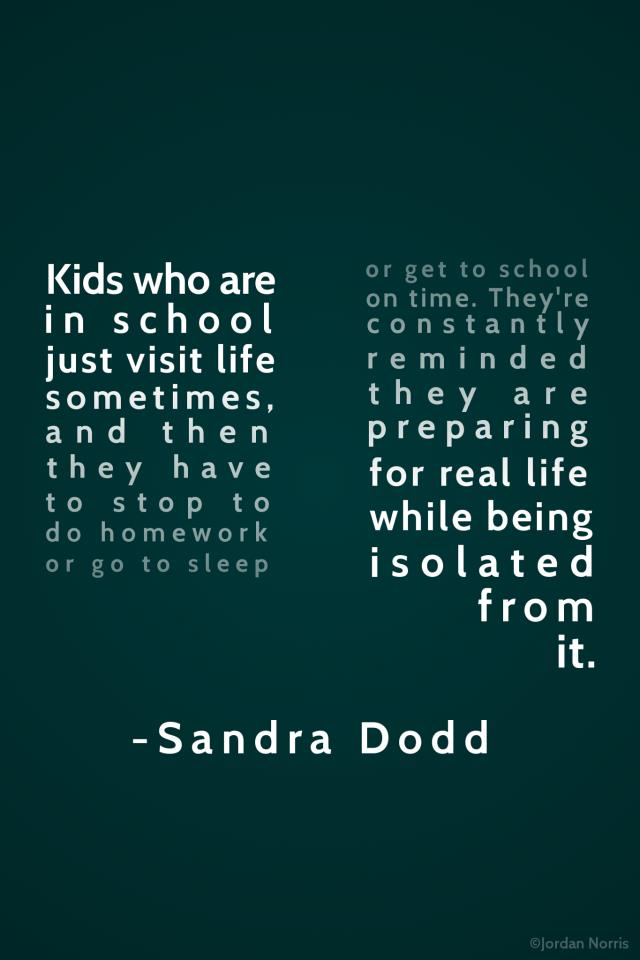
Unschooled children learn at their own pace, following their own interests because every child, every human, is unique. The beauty too is that an unschooled child’s learning is unlimited regards times and days, they don’t stop learning at 3pm, in fact Sandra Dodd created an annual ‘learn nothing day’ as a funny challenge to unschoolers, because its literally impossible to go a whole day without learning; if you’re living, you’re learning, remember? So that might be why you get a funny look from an unschooler if you ask them if they enjoyed the weekend/the holidays/the summer etc, because for them it doesn’t differ to any other time of the year.
I know what you’re imagining now; two out-of-control, unruly, spoilt children with no structure or rhythm to their day, doing what they want, when they want…? some of those may be true at times, I mean I do have a 5- and 2-year-old, it gets pretty messy here, but unschooling doesn’t mean no boundaries, consequences or rules. It simply means that as their parent I respect child-rights. I don’t believe something should be done just because I say so. I value their opinion (yes, even a 2-year-olds) and I respect them. I take so much joy asking them ‘what should we do today?’, ‘what should we put on this week’s meal plan?’, ‘what do you want to wear today?’
When I pause and reflect on our society at large, I see long working hours, limited free-time, work hierarchies…what we commonly refer to as the rat race. This also describes the school system; long working hours, limited free-time, work hierarchies. Both out-dated, broken models built within the industrial revolution to churn young children out into hard working adults for the system. Our curriculum is a fantasy, a man-made reasonably new idea and its failing, year on year; it is failing the teachers, the students and the families.
As you can see from the previous paragraph it is very easy to jump up and shout loudly about the broken system we are constantly feeding. Choosing to walk another path is a form of activism. It might not be marching in the thousands with pickets and banners, but vocalising your distrust in the current educational set-up of this country, in going against the grain, you are shouting loud and clear, even when you’re peacefully typing. My job here isn’t to preach, to judge or to lead the way. I don’t really know what I’m doing, if I’m honest. But for those curious, for those who can’t face another morning battle with their children to get them fed/washed/dressed and out the door by 8am, for those who feel that something is wrong with their weekly schedule of 5 separate family members being in 5 different places 5 days of the week, for those in a job they hate- not wanting the same for their children…well I’m here to accompany you and show you there is another way and hopefully help make it more accessible for more people by making it a topic that gets discussed, challenged and explored in every household.
Having a no-school approach isn’t accessible to everyone (especially not immediately). Single parents, working parents, isolated parents…many socio-economic reasons can leave a family relying on school as childcare. I aim to be mindful around this as I ongoingly post about my journey into unschooling. But I enthusiastically believe there is a way, especially as the masses work collectively to demand change. As we group together to create alternative ‘educational groups’, or even support each other with childcare to allow a parent to carry on working. We can also teach each other how we can live simpler lives, needing less money; growing our own food, creating community gardens, cooking together, mending broken things, consuming consciously. Returning here to the concept of unschooling as an overall lifestyle choice.
If school has to be an option for you currently, then getting involved with schooling decisions is your form of activism; challenge the synthetic uniform, ask for an alternative to homework, encourage a vegetable garden for the students to grow food, demand an organic/vegan option in the cafeteria. There are so many areas of our lives we can tweak here and there to be an activist in our own way and even more varying options to what schooling has to look like, we just have to do the work to find different answers.
Unschooling will look different for every family. Think of it more as a parenting style, than an educational one. Elements of unschooling can be woven into your family even with a child still in school; it’s what you emphasise in their lives. If you focus first and foremost on your relationship with your child, their relationship with themselves and their relationships with others, if it’s the emotional needs taking priority over whether or not they can read and complete homework on time, then you already have something in common with unschoolers.
I hope I’ve given you a glimpse into another world that’s possible without school. A world where family members are equals, where living is learning and where unschooling is a by-product of a chosen lifestyle.
*This post feels incredibly condensed for the huge topic that it is, I tried to cover all bases, vaguely. This is very hard when you’re so passionate and enthusiastic about something. I will do separate posts on topics such as ‘a day in the life of an unschooler’/’book recommendations for exploring unschooling’/’why I don’t teach my children’/’examples of organic learning’… if you have any questions or something you’d like me to delve deeper into, then please do contact me.

 thelivingfamily.blog
This is a great insight into unschooling well written Nicola We look forward to the next ine
LikeLike